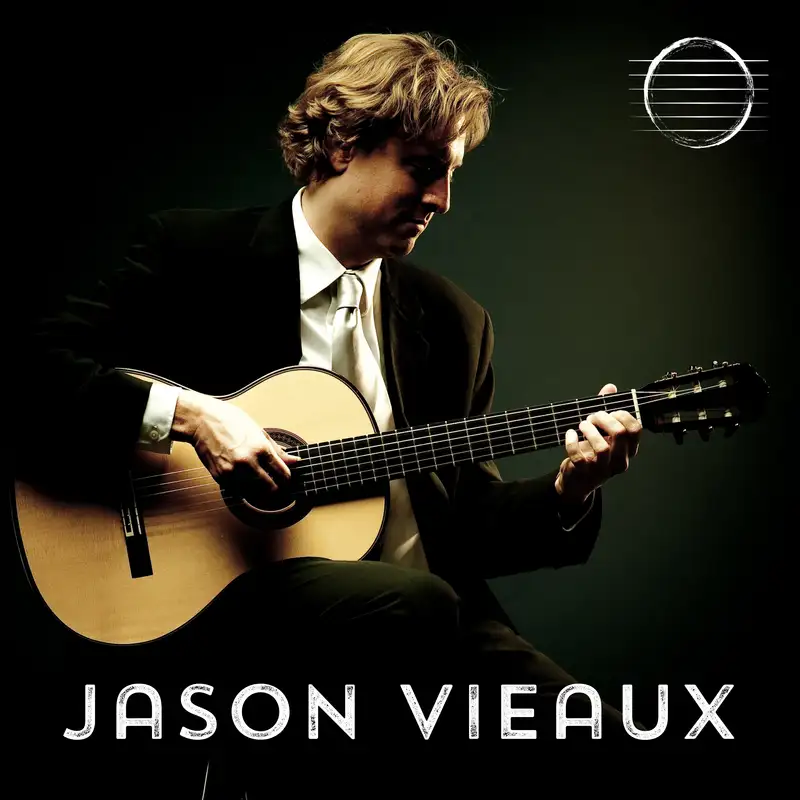
Jason Vieaux
Welcome to the pluck. This is a show about how we write, record, and play music for plucked string instruments. That's guitar, guitar, bass, banjo, mandolin, anything with strings that you can pluck. It's designed for serious players like composers, songwriters, producers, and educators who can already make music but want a clearer path for turning these ideas into finished and performable music that feel good under the hands and are good for the stage and the studio. Each of these episodes is a long form conversation with someone living this life in the real world so we can borrow their principles and hear their stories behind the records and the scores and build our own shared language for plucked string music.
Jonathan Smith:Today on the pluck, I'm joined by Jason Vieux, a Grammy winning classical guitarist described as among the elite of today's classical guitarists from solo recitals and concertos on some of the world's greatest stages to collaborations that stretch across classical chamber and jazz influenced music, Jason has built a career that's both deeply rooted and wildly curious. He's also a respected educator, helping guitarists around the world refine their sound, technique, and musical voice. So I'm excited to dig in into how he writes, records, and plays at this level. So, Jason Hi, Jonathan. Where are we catching you today?
Jason Vieaux:I'm actually home, in between, concerts and teaching at Cleveland Institute of Music. So I go tomorrow to, Columbia, South Carolina to the university there and play recital and then do a masterclass, there. And then on to Mesa, Arizona with, Grammy winning cellist, Zul Bailey. And then from there to DC for a program with Anakiko Myers. It's kind of a tough week because it's three different programs in one across, seven days, seven or eight days.
Jonathan Smith:That's a lot for one week.
Jason Vieaux:Yeah.
Jonathan Smith:Yeah.
Jason Vieaux:Yeah. I've done it all I've done it lots for many years, but, yeah, it's it's it's very hard to control the booking, especially when you have kind of these bigger series. You know, you don't want to you wanna try to maintain those relationships and such. So sometimes they just don't fall exactly where you would like to have them. But Mhmm.
Jonathan Smith:How do you keep up with so much repertoire in such a small amount of time?
Jason Vieaux:As I tell my students, I I start early and and often as possible. I mean, I I I realistically, I only really get about maybe three hours a day to practice because most of most of my time around the classical guitar is is a lot of office, you know, office work between two guitar departments and then just, of course, the concert business and maintaining those relationships and with collaborators and conductors and that kind of thing. So it's so I try to start you know, I'll my calendar is a very interesting thing to people because I'll pick a date that's, you know, fairly far out. It gives me more than enough time. At this point, of course, I know I can look at a piece of music, and I can pretty much pinpoint how long it's gonna take to learn if it's new or how long it's gonna take to refresh if it's something I've played before.
Jason Vieaux:And those all go into the calendar, like, start, you know, Gnathalie cello sonata.
Jonathan Smith:Or Mhmm.
Jason Vieaux:Or start this or start you know, Rodrigo considered iron wise, I've played, you know, over 200 times, so that doesn't require quite as much work to get it back together. Mhmm. So I can do that in about a week.
Jonathan Smith:So do you literally put that in your calendar, like Yeah. When to start practicing Yep. Those Excellent. Excellent.
Jason Vieaux:And I keep logs. Like and then in my notes, part of my phone, I keep logs of how much I've well, you know, if I, you know, I put check marks. Okay. I got it this many times and that just keeps me honest, you know. Keeps my stress level down too.
Jonathan Smith:Along this path of preparing the music, what helps you get ready for like that first rehearsal, like like mentally that you feel like you feel like, oh, this is ready. How do you know when you're ready?
Jason Vieaux:Well, if it's newer pieces, you don't really quite know until you get into the first rehearsal. So you, if it's something fairly new, like, for example, a week from this Saturday with Anna Kiko at Dumbarton concerts in DC, that's you know, that program now we played, recently in January, but a lot of that stuff was the first time I played, you know, those pieces. So the amount of work leading up to the first concert was a lot more than the next. You just have to maintain it. And, really, the hardest the hardest thing on the program to play, I would say, would be the handle, violin sonata, the the continual part that, Andy Paxson arranged for me.
Jason Vieaux:He was a former student of mine and an incredible musician and guitarist. So it's just just a matter of kinda staying with it and not, you know, leaving it until the last few days before rehearsal. But, yeah, first rehearsals are always a little bit like, well, you're kinda feeling your way through. But with experienced musicians, you know, it's really just a playthrough. You just do do just a kinda nice nice easy playthrough, and then you kinda work on some details on a second run, and that's honestly, like, that's usually about it.
Jason Vieaux:Mhmm. It's not a lot of rehearsal that it's not it's not the kind of real, focused dedicated rehearsal that, say, a dedicated duo might have. Right? Mhmm. Where they're more like they're they're very polished almost like a like a diamond, you know, in that sense.
Jason Vieaux:They have that opportunity if they're if they're together, and then that's kind of their main gig. Right? Mhmm. In mainstream classical music, a lot of these things are a type of, collaborations where you get together for a few concerts during the season, And the presenters are excited by that often in in the mainstream kind of thing because it's, you know, two names of their instruments. Like, Anakiko is a big name on violin.
Jason Vieaux:So
Jonathan Smith:Mhmm.
Jason Vieaux:You you when you partner up like that, it's kind of like a it's it's a you're bringing sort of the fan bases from both of those those two musicians together. Right?
Jonathan Smith:Mhmm. Very interesting. So there's a whole different kind of energy, I guess, between these these concerts where you only meet once or twice and then you play it. And then there's, like, these concerts where maybe you have an established ensemble Yeah. You know, that that you've been rehearsing with for a while.
Jonathan Smith:There's a different energy.
Jason Vieaux:Oh, yeah. Yeah. It it feel it feels very different once you've gotten the first couple concerts out of the way, like, once you've gotten them done. And the first and the first one we did about a month ago was it went terrific. So and then the week before that, I was with Yolanda, and we were doing a couple world premieres on that one because we're we're we're gonna slowly the idea is that we slowly add world premieres until we have enough to make a new album and to to the sort of the the twelve year follow-up to, together, the together album.
Jason Vieaux:See that once we once we basically played that record, that was our program for, like, you know, five, six, seven years or something like that. And and, yeah, it was a very well oiled machine, of course, after the first year.
Jonathan Smith:Is this is this a normal thing to to kind of play a a lot of concerts ahead of time and and then cut the record? Or how does
Jason Vieaux:that work? Yeah. I think in the case of Yolanda, that's the way we we did it. You know, it's it's always a look. It's better I think well, not necessarily.
Jason Vieaux:I mean, but usually, if you've played the material, you're a lot more comfortable. There's a lot less, going back and forth, I think, in the recording process if the the performers already know the piece and they've already been playing it. In the case of Anne's record that I did in 2021 called shining night, that was something where we had done a couple concerts where we played the Piazzolla history of the tango. But then Anne is Anne and Yolanda both are very focused on programming when it comes to a CD when it comes to an album and the and the track order and what things would go well together and a theme. There's almost always a kind of a theme running through it, like a narrative, that where the title is a reflection of that and a reflection of the pieces.
Jason Vieaux:So a lot of that with Anne, for example, it's you kinda play them. I think a lot of that record was done for the first time in in the recording process, which, you know Mhmm. Was, you know, a little bit kinda, you know yeah. There's definitely an element of the unknown there, and David Frost is, like, you know, producing, and Silas Brown also producing, like, two multi Grammy winning producers and stuff. So it's it's, you know, it it's definitely a definitely a different kind of thing.
Jonathan Smith:Mhmm. You're discussing a lot of, like, collaborations as a guitarist as a classical guitarist. Can you talk a little bit more on this experience? Do you find it to be an important element of your career? And how important would it be for other guitarists too?
Jason Vieaux:Well, I think as a model for other guitarists, it's it's good because if you can I mean, of course, it depends on your ability or capacity to learn lots of repertoire? I mean, I've been basically playing anywhere from seven to ten hours of different repertoire for, I don't know, almost twenty years now. Mhmm. And and the bulk of that per season, of course, is collaborations because, you know, even concertos, I think the the most number of the the I mean, a given concert year, I may have played, like, the two Rodrigo and a Vivaldi and maybe, like, one other one, like, Villa Lobo within a season, but that's about it. Right?
Jason Vieaux:And all those I've played many times. So collaborations really do add. That's the thing you wanna tread the one wants to tread carefully because it really does add a lot to your practice. You know? Mhmm.
Jason Vieaux:And now as I'm getting into more, oh, I guess more of a I'm in my early fifties now, and my kids are growing up, and I like to be with them. You know? I don't wanna be practicing six hours a day when I'm home. That's I mean, first of all, it's almost impossible to do that anyway. But Mhmm.
Jason Vieaux:But you try to combine some of the things too. Like, Pizzola history of the tango is a very, you know, durable, you know, multipurpose kind of thing. Like, you could play with violin. You could play with, you know, flute. I've done it with Ben Donion, of course, with Julian.
Jason Vieaux:There's a there's a lot of people that wanna play that piece. So that really opened up a like, the Piazzolla and the Defaya, seven songs or six songs if you're playing it with a cellist or violinist. Like, those really open up a lot of those open a lot of doors for me for to chamber music festivals, and that's how and then just through through the concerts themselves, the rehearsal process, there's a lot of, you know, there was a lot of, you know, hanging out and partying and stuff in the in the odds and the tens, especially. You know, you make all these friends, and then they tell their friends. They they're all they all got cheer music festivals around the country, and then they pass the word on.
Jason Vieaux:And now we've you know? Oh, we just had, you know, this guitarist, and, he was he was great hang, and he you know? And the audience loved the music. And and so there's though there there are these kind of usual suspect pieces that really are are kind of the centerpiece of the thing. And and crowd the audiences go wild for the Pizzola.
Jason Vieaux:I mean, they really do. It's just such a it's just a sure shot. It's, you know, it's just one of those sure shots. It's not gonna fail.
Jonathan Smith:What what made that piece become that, do you think?
Jason Vieaux:Well, I mean, Piazzolla's music is very attractive, of course, and and very melodic, and he's one of the most popular twentieth century composers of all time. The music's very accessible. And, you know, those those particular movements in his history of the tango, I would say, particularly, this the second and third one are really a plus. You know? Like, that's, like, kinda like Yeah.
Jason Vieaux:Those are two of his really best things, I think. The most the most enduring, melodies and and compositions. So we are very we're very blessed to have that on guitar. I mean, I can't I I can't say enough about them really in that regard. In terms of what it does professionally for guitarists, it opens a lot of doors.
Jonathan Smith:Interesting. It's like this piece, like you said, is so accessible. It's easier for even, like, someone who doesn't know the piece to really latch on Mhmm. You know, to the feeling
Jason Vieaux:Right.
Jonathan Smith:Of it. And the two movements you talk about are cafe and Nightclub. Nightclub.
Jason Vieaux:Yeah. Absolutely.
Jonathan Smith:Yeah. And which is a slow movement and a fast movement, which I think are commonly paired together, like if you don't program all four
Jason Vieaux:Right. Movements. Yeah. Those are good. That's a good pair, actually.
Jason Vieaux:Yeah.
Jonathan Smith:Yeah.
Jason Vieaux:It's an ideal pair.
Jonathan Smith:Yeah. Do do you know anything I personally don't. But do you know anything about the history the history of that piece and how Piazzolla wrote it for the guitar? You know, like
Jason Vieaux:All all I know is that yeah. All I know is I was Alvaro Piari played it, and I believe he played it with Pizzola, the premier in '83. I wanna say '83, '84. I know it was written in the eighties. And Alvaro Pierry was, you know, kinda his guy for for that, and I would imagine that Piero probably helped with, making the stuff fit on a guitar.
Jason Vieaux:Right? Because Yeah. It's not it's not the most idiomatic left hand. You know, I use a lot of, that's that's probably one of the early pieces when I was in college that I learned how to use my l h four, as a barre as a barre.
Jonathan Smith:Oh, interesting.
Jason Vieaux:Which I use all the time now. I use it, like, I use it in every situation like that I can now. It just become it just became second nature to as a as a fingering option.
Jonathan Smith:That's interesting. Do you recall what part of of the piece that you used that as a Oh,
Jason Vieaux:it's in the fourth movement for sure. I think I used it in the second movement even.
Jonathan Smith:Mhmm.
Jason Vieaux:If you got that if you got that, f sharp diminished and you got the fifth fret top three strings on the fifth fret, I just you know, I'd much rather I would much rather just slap the four on the on the top top three strings and then then and, you know, use the low f sharp and and that kind of thing. There's just situations like that. I can't recall it off the top of my head exactly, but there's a lot. I mean, I use it so much now that Mhmm. I don't even I can't even count the number of situations where I use it.
Jonathan Smith:You you came up with, like, a solution to make it not only playable, but also, like, just musical. Yeah. Too.
Jason Vieaux:So it's more legato. So the lines connect. You
Jonathan Smith:know? Yeah.
Jason Vieaux:Yeah. Yeah. And bass is important too. Like, the bait for me, the bass and the way it moves in in his music is is really important. That's you know, that you're basically like the orchestra Mhmm.
Jason Vieaux:In that in that piece.
Jonathan Smith:Mhmm. Yeah. It's such a beautiful work, and and that makes that makes a lot of sense of why it's been so successful. I like to branch from there while we're on the topic of guitarists working with composers. That's a very interesting topic to me.
Jonathan Smith:I wrote my dissertation around that, how non guitarists, composers write for the guitar. Right. You know, and that that is a common theme we see in guitar literature.
Jason Vieaux:Yeah.
Jonathan Smith:And so I I recall this was back in like 2020 now, but I interviewed both composers and guitarists, you know, including, you know, Robert Beezer and Elliot Fisk Yep. You know, and, you know, their collaboration on mountain songs
Jason Vieaux:and Yeah. It's fabulous.
Jonathan Smith:And things things like that. Can you recall any moments of working with some of these some composers? And, you know, give those some examples.
Jason Vieaux:Yeah. Some exam it's it's been so many now by this point of premiered I mean, it's probably well over 30 pieces and some some pretty some pretty substantial composers and names like Vivien Phong. These are more like kinda mainstream classical composers. Avner Dorman, The film composer Jeff Beale wrote a guitar and string quartet for me, and then we expanded that into kind of like a, you know, chamber concerto, and recorded that for BISS in 2016. And Leshnau Jonathan Leshnauf and and the the all four of these composers right now just off the top of my head, none of them none of them play guitar.
Jason Vieaux:And so they all had different slightly different approaches. I mean, most of the time, they're pretty easy. Most of the time, a composer really wants the feedback from the guitarist because they they don't want it to sound overly difficult for them. They want it to the music to flow. But sometimes you'll get sometimes it's there's a a composer like, Leschoff was an example of that.
Jason Vieaux:That was a project that I had taken over, with Nashville Symphony. He had written a guitar concerto, and Bar Waco had already done the live premieres, I believe Mhmm. But not the premiere recording. And and I think what hap you'd have to ask Manuel about it, but I talked with Manuel a couple times on the phone about it because I was I was I was somewhat surprised at how resistant, initially, mister Leshnoff was to, be, like, you know, taking, say, the first movement and taking four of these kind of examples and say, well, this this isn't really actually playable, much less too difficult for me. It's just like the there's an f sharp down here on this on the sixth string on second fret and then a c sharp on the on the ninth fret on the first string.
Jason Vieaux:I mean, that's not gonna you know, can I I propose that we flip the bay you know, bass up an octave? That's like a regular thing that you do in the guitar. Well, a lot some of those things he was okay with, but then some of them, it was surprising. He really he wasn't. And which was which we kinda had come to an impasse a little bit.
Jason Vieaux:And Baruaco, when I talked with him, he had come to the same kind of impasse. And, somehow, I managed to convince him that Andres Segovia, John Williams, Julian Bream, Sharon Isbin, Elliot Fisk, on and on, you know, they they were given a a certain level of or a certain measure of of freedom to, to at least initially suggest other solutions that were that were playable to the instrument. And and particularly if you could write, if you can compose and you and I'm, you know, and I was arranging, you know, things in high school, for solo guitar just for fun, just, you know, for my own enjoyment.
Jonathan Smith:Mhmm.
Jason Vieaux:You can you can find these kind of solutions pretty quickly. It doesn't take very long. So I kinda hashed it out with him on the phone, and and even after the it was kinda it was eight spots. It was, like, eight spots in the concerto. And and he said, well, okay.
Jason Vieaux:Well, they sound good when you're playing them over over the phone. It was kinda like a video conference kind of thing. I don't even think I had Zoom yet. This was, like, in 2016 or '17. Uh-huh.
Jason Vieaux:And he said, okay. Well, they he's like, well, it sounds good, but just please please please try to play play it like I like the way I wrote it, exactly the way I wrote it, which didn't really make sense because like like, because it was they were unplayable in that sense. So so, anyway, I consulted Barojeco. I consulted Manuel, and I consulted Roberto Diaz, my boss at Curtis, because he had played two different pieces by Laschnoff. One was a viola solo piece that was very playable for the viola, and it was like a solo spot, like a almost like a like a chamber concerto.
Jason Vieaux:And then the other one was a string like a string quartet, and he and he said that part was had the same kind of problems, like, where there was, like, a big stretch across the viola that would would like, you had your fingers would have to be, like, you know, 10 inches long in order to reach the thing. And so Mhmm. So he said, you know, he had just suggested just just go do your changes, do your edits, and just plan. That's it. That's all you can do.
Jason Vieaux:You do it's out of your control at this point. And that's exactly kind of that's exactly what I needed to hear. Like, you have to you have to be willing to just sort of go there and and and maybe, you know, I don't know, get yelled at or something. I don't know. So Right.
Jason Vieaux:We're in we're in the read through at first rehearsal in that beautiful that gorgeous orchestra hall that Nashville Symphony has in there. A great orchestra. Just really great.
Jonathan Smith:Uh-huh.
Jason Vieaux:Reading through the first movement, and and Leshnaus, you know, sitting in the hall, and he's got a he's got a light. He's got one of those light flashlights on his on his forehead, like, you know, and he's looking
Jonathan Smith:at see the score.
Jason Vieaux:So he can see the score in the dark in the dark in the hall. Uh-huh. And he's going over to whatever, and then we've we've read through the first movement, you know, and, of course, I'm playing what the what I can play. And he slowly gets up from his chair, and he starts walking towards the front of the stage with, like, with real direction. And I'm thinking, okay.
Jason Vieaux:Here it comes. Here's here we go. And he and he just he looks up. The stage is really raised from the floor. He looks up and he goes he goes, it's amazing.
Jason Vieaux:It's fantastic. Just, you know, just do just keep just, you know, do what you're doing or whatever. He would say that after every movement. I was like, it's okay. He's like, it's it's wonderful.
Jason Vieaux:It's just it just sounds great. It's like he had to hear it with the he it's a trust issue. He didn't try you know, it's which I totally understand. It's his baby. And that piece, by the way, is just a fabulous, fabulous concerto for guitar.
Jason Vieaux:I just think it's one of the best things ever written for guitar and orchestra. It's so beautiful and and exciting and and and pyrotechnic and, you know, like, know, great, you know, great flash and great lyricism, and and it's wonderful. So Mhmm. Yeah. After the third movement, he said the same thing, and then we're on our way, and everything was peaches after that.
Jason Vieaux:You know?
Jonathan Smith:Right. So he had to hear you.
Jason Vieaux:He had to hear me. That's it. That's all it was. I I had I had this thing in my head that wasn't real. You know?
Jason Vieaux:I had this kind of fear in my head that wasn't, that was not real. That was not reality.
Jonathan Smith:Mhmm. Mhmm. Mhmm. Yeah. You you you didn't wanna disappoint him.
Jason Vieaux:No. No. Yeah.
Jonathan Smith:And but but you really wanted to serve serve the music and just play your play your best in those moments. Yeah.
Jason Vieaux:Yeah. I mean, if it was just for a performance, I think the stress of it would have been a little bit less. It it's just the fact that it was gonna be a live recording. They were gonna record all three concerts live, and then that's it. That's what you get.
Jason Vieaux:I mean, we had a patch session for ten minutes, and most of it was for, solo instruments that the in in the orchestra that had a brief solo. And I think I got I got one I got one or two takes on, like, the one thing that he allowed me to do. That was it. That's I mean, that that what you hear on the recording is like, this is stitched together from three live performances.
Jonathan Smith:So the the patching process with an orchestra, how how does that work?
Jason Vieaux:Well, you're you're just sitting there. The the the voice comes in over the the intercom and and, you know, they he's already briefed Maestro, you know, Guerrero there on what they're gonna what they're gonna try to get in in about a, you know, half an hour or twenty minutes or whatever it was. It felt like it was it felt like ten minutes, like, that we that we had for everything. You know?
Jonathan Smith:Wow. And did you have any say on, like, oh, can I can I punch in, like, this measure?
Jason Vieaux:That measure? I mean, could say you can you can say. You can ask. You can always ask, but it's a time thing because it's union and they they only had a certain amount of time to get it done. I thought it turned out great.
Jason Vieaux:I mean, for a live for a live recording, like, that's, you know, that that's that whole series on Naxos. It's all American composers. That's those are all basically, like, they're they're edited live, but they're live with an audience there.
Jonathan Smith:So is this piece on a on an album with other other works? Is that what Other
Jason Vieaux:works by Leshnow. So he got By Leshnow. That's and and again, that's probably why, you know, he was so invested in it because you know what I mean? Like, because that's one in the Michael Dougherty, you know, got has one and, you know, it's an it's a it's a series on Naxos specifically, you know, around one composer. Kip Winger.
Jason Vieaux:Do you remember Winger, the the the hair metal band? Mhmm. So he's he was he was a classical music composer before, you know, he was a composer before Winger. Right? You know, as I like to say, Winger were all a bunch of ringers.
Jason Vieaux:You know? There are there are a lot of so the great know, like, really great musicians that got in on the hair metal thing at the you know, while it was really hot. Yeah. So he got one too. You know, he's he has a series.
Jason Vieaux:He has a a CD of all all, you know, Kit Wenger with Nashville and Guerrero. It's a wonderful series.
Jonathan Smith:Excellent. Excellent. How cool.
Jason Vieaux:But I would say that I would say that in comparison, it's usually a lot easier. Like, you know, if if, you know, Abner Dorman and I just basically texted each other. I would write out my solution, text it to him. He'd read it over. He's like, yeah.
Jason Vieaux:Looks good. You know, he didn't really didn't really already changed his.
Jonathan Smith:A whole different exchange. Yeah. And
Jason Vieaux:I'm the kind of guy that would welcome if another guitarist wanted to play how to love for guitar and string quartet, and they wanted to have a go at their own edits and that kind of thing with with Abner. That would be totally fine with me. I've never I've never, you know, needed to claim ownership over it or anything like that. I think just because you end up being the one that premieres it, and then I played that piece a lot, you know, afterwards. So Mhmm.
Jason Vieaux:It gets associated with you. But if if one were to tackle it, I you know, I would I would welcome, you know, any solutions that that they might have, you know, for for some of those things that were unplayable.
Jonathan Smith:Mhmm. Do you have any do you have any suggestions for like composers who are curious about writing for the guitar but not sure where to start?
Jason Vieaux:Start with a guitar player. You know, I mean, if you get a if you could work with a really good guitar player, that's that's the thing, especially with I think particularly with Bream was I think the relationships those working relationships with, say, Benjamin Britten, Malcolm Arnold, there are you know, there's a lot of English composers, but also Toro Takemitsu, they just hang out for, like, a week or two at his house or at their house. And they would, they would just go over it. You know, they would just go over the score and, you know, make it fun. You know?
Jason Vieaux:Though those that's what those are really fun when that happens like that. And Mhmm. That way that way it's all done in one shot. The composer sanctions it. Guitarist feels comfortable enough playing it, and that's the right way to do it.
Jason Vieaux:Segovia, I think, had to do Segovia had to do a lot of that stuff with Caso Ostadesco by letters because he was just never not on the road. I mean, his life was just, to me, like, absolutely crazy. Mhmm. So the a lot of the correspondents, you know, they rarely were able to get together.
Jonathan Smith:Mhmm. And
Jason Vieaux:some of those some of those, suggestions that Segovia had, Kessel Otedesco was okay with, and then some of them was like, well, I don't know. You know, it's it's a little bit like that. Ponce was a little bit more, you know, open or forgiving or in that sense. You know? So but Segovia just did an unbelievable amount of of of those kind of things for guitar.
Jason Vieaux:Right. It's just hard it's just hard to imagine that he ever slept.
Jonathan Smith:Yeah. Yeah. Especially given given the context of some of those letters.
Jason Vieaux:Yeah. I did the writing letters. Right?
Jonathan Smith:Yeah. Yeah.
Jason Vieaux:I mean, I get Yeah. I get I get I get pissed off if I if my voice dictation doesn't take on the on the phone the right way, and I gotta go back and change a word or two. Like like, you know, I mean, could you imagine? I mean, just handwriting these letters. Yeah.
Jason Vieaux:And then picking them up in the post office in Barcelona or in, like, in Italy or I mean, just crazy.
Jonathan Smith:Right. Right. The the pace the pacing of things, much different.
Jason Vieaux:Yeah. You could feel the urgency in those letters when you read them. You could just feel the stress coming coming coming from both of them, but particularly Segovia.
Jonathan Smith:Yeah. Yeah. So so how is, how is technology today? How is it, helping or hurting us with the collaboration?
Jason Vieaux:Oh, I think it's I think it's definitely helping because it's much more like, if you were a composer and I and we were working on this just like right through this this this medium that we're using right now, it would be Yeah. It was very easy and very quick. It saves a lot of time. Mhmm. You know?
Jason Vieaux:Mhmm.
Jonathan Smith:And I would also say, but there's also a different sense of urgency, too, with technology, how quickly it is to access each other, just through stuff like that. And so we have to there's a little balance there I've been finding too, this balancing communications. You know, because everyone can access you so quickly. Right. Right?
Jonathan Smith:So how do you manage that balance
Jason Vieaux:Oh, yeah.
Jonathan Smith:As an artist?
Jason Vieaux:What I call office. Yeah. That's
Jonathan Smith:Yeah. Right.
Jason Vieaux:Yeah. I mean, my my some of my colleagues, a couple of them laughed at me. They they they they sort of giggled when I said, oh, you know, I gotta go to the office. You know? In the late nineties.
Jason Vieaux:Oh, the oh, your office? You mean your part your one bedroom apartment? But it was but, you know, if you think about it, it really was the beginnings of a of an office with my my manager as the center. And then, you know, guitar presenters were really not comfortable back in those days approaching a manager. So we had I had an agreement in those early days, late nineties, early two thousands that if a guitar festival or a guitar series wanted to approach me to let you know, sometimes if I a lot of it is just feeling it out.
Jason Vieaux:Like, you know, she had to trust me with the sense that, let me talk to them first. Talk about what they let's hear about what they want or what the the in terms of repertoire and then what I can do for that season without getting myself into too much trouble. Mhmm. And then, you know, I got this Ponce record coming out, the Sonatas. I'd like to play at least one from that and da da da da da.
Jason Vieaux:And then and then you and then you hand them over. Then they're then they're more comfortable to finish off the contract to talk about money with with the with the manager, and that was kind of like a regular thing. Because I always wanted to have one foot firmly planted in the guitar scene. Mhmm. Right?
Jason Vieaux:And to continue to build that, but also through the collaborations and through orchestras. You know, you get solo recitals. I I I get I've gotten lots and lots and lots of solo recitals on mainstream what I've been calling mainstream classical series for sure. Mhmm. But to really build the relationships in that at that end of the business, you it's really collaborations and concertos.
Jason Vieaux:Like, orchestra's a different world. It's an entirely different world from chamber musicians. And they're they're they're all they're like a different they're a different universe to from from each other.
Jonathan Smith:Yeah. Yeah. That makes sense.
Jason Vieaux:So that office thing becomes very, very important. You start to figure out, like, oh, wow. This this stuff takes a lot of time. You know?
Jonathan Smith:Mhmm. Yeah. Because you you have to use that time to bridge to be to be a bridge for these opportunities.
Jason Vieaux:That's right. And to be available. I mean, like, you don't have to be Yeah. On call like a doctor or anything, but you gotta be available. Right.
Jason Vieaux:Because they're putting the they're putting a brochure together. They're putting a season together, and they want they wanna do one that's focused on guitar. And some of them just want all Spanish and Latin American or some want, well, we like these newer things that you do too. We would love to hear the Vivian fun. We've got a violinist.
Jason Vieaux:Right? Mhmm. Or something like that. You know?
Jonathan Smith:So with this office idea, are you do you have office hours as a musician?
Jason Vieaux:I've tried and tried to do that. It's I I like to I'd I'd rather do a lot of that stuff in the morning, but the problem is with your when you're teaching at two conservatories and you're doing all this touring, it's it I, you know, I, after a while, I learned, well, this is gonna push my practicing into the evening or into the afternoon and stuff like that. And I try to get you know, it's my day goes much smoother. You know, my ten to twelve hour day goes much smoother if I if I start with practicing.
Jonathan Smith:You start with practicing.
Jason Vieaux:Right. Because then you, you know, because then you've got some time in. You're then you get if you can get a grab a third hour later, you know, you icing on the cake. Mhmm.
Jonathan Smith:Yeah. That makes sense. It's starting the day with, you know, something very important. I mean Yeah. To keep up your job so you do well in those evening recitals and concerts.
Jason Vieaux:Yep. Yep.
Jonathan Smith:Yeah.
Jason Vieaux:When I started out, it was always much more comfortable to practice at night because your because your brain was just used to performing at night. And it's still kinda like that. You know, they're still like that. It was when I was in my twenties, it was very hard it was very hard to start practicing at, like, eight in the morning or something like that. Very difficult for me.
Jason Vieaux:Right. Because I never did it in high school. I never I never practiced before 3PM in high school,
Jonathan Smith:you
Jason Vieaux:know, or or or, whatever grades what? Was at eight when I started. So grade school, I never started. I never I you know, you hear those stories about pocketing. Like, his father would get him out of bed at, like, 5AM and stuff and then make sure he practiced a couple hours before he went to school.
Jason Vieaux:You know, we never I'm my parents my parents never did that.
Jonathan Smith:Yeah. Right. So you started when you were eight? Eight years old? Wow.
Jonathan Smith:Yeah. Wow. And
Jason Vieaux:Yeah. Right in either one week after my eighth birthday or one week before. It's it was in July.
Jonathan Smith:Okay. So you were around, what, third grade?
Jason Vieaux:Yeah. I guess so. Yeah. Sounds about right. It's third grade.
Jonathan Smith:Somewhere around there. And did you start on classical guitar?
Jason Vieaux:Yeah. I started with I started with a founding member of the Buffalo Guitar Quartet where where I grew up. Jeremy Jeremy Sparks was the primary arranger, for the for the quartet, and he mainly played kind of the sort of the parts that John Diarman, I guess, might play in, you know, Los Angeles guitar quartet, like, kind more of the lower lower voice space parts and that kind of thing.
Jonathan Smith:Mhmm.
Jason Vieaux:Mhmm. Because he is busy with arranging. I mean, they're like, a lot of their the bulk of their recitals were his arrangements at the back at that in those days.
Jonathan Smith:Mhmm.
Jason Vieaux:So I got a great chamber music training from him because we played duos a lot in lessons. We played a lot of duos. We went through those Mhmm. I remember, like, a big book a big anthology for me was that Node Renaissance anthology.
Jonathan Smith:Oh, yes.
Jason Vieaux:Yeah. I learned everything in that in that book and all the duos. I would just play with my teacher in lessons. So I got a nice early, chamber music training there as well. How to listen outside of what I was playing.
Jason Vieaux:How to listen outside of myself.
Jonathan Smith:Yeah. There's an element about that that's I think I think really advantageous for a young player to to not just, like, kind of be so focused on your own thing, but to share it with your teacher to play with your teacher. Yeah?
Jason Vieaux:Right. I call it I call it antenna. It's like I'd call it chamber music antenna for for my students. So he's like, you know, yeah, you're you're in, you know So, you know, some of them are quite good at it, you know, naturally, and then but then some are yeah. They're they're kind of in soloist mode, and I can tell they're not listening to their to their partner.
Jason Vieaux:And Mhmm. Or they or they don't know the score, or they don't know their their partner's part, which is super super important.
Jonathan Smith:Yeah. Yeah. So so so you're not like a solace on the side, but you're you're weaving in your your part with theirs.
Jason Vieaux:Yeah. Yeah. Yeah. You're the accompanist in most of those situations. I mean, the vast majority of them.
Jonathan Smith:Right.
Jason Vieaux:You're accompanying them, not the other way around.
Jonathan Smith:Mhmm. So So so those earlier lessons really taught you a lot about collaboration. And so no wonder no wonder you are where you are now from the those initial experiences.
Jason Vieaux:Yeah. Because then when I got into college, I just started collaborating not only with classical pieces, standard repertoire, But I'll you know, I'll look like two doors down in the or next door, actually. Next door in the dorm my freshman year was a composer, Paul Osterfield, and he asked if I would he's you know, I'd be playing you know, I'd be practicing three or four hours a day once I got to college. And, practicing in sometimes in my dorm room and the word got around, like, people wanted to collaborate with me. Two doors down the other way was Evan Price, and we start and he taught me how to read, chord symbols.
Jason Vieaux:He taught me how to read a lead sheet.
Jonathan Smith:Ah.
Jason Vieaux:And then we ended up starting a little band together with a percussionist, Damian Bassman, and we had a little, jazz trio. Made a Nice. We made a demo. My my roommate was Alan Bice, who's recorded all my albums and has won like, he we won a Grammy together, and he won two Grammys with Ataka Quartet, the string quartet. And, so he's he's rolling.
Jason Vieaux:Not you know? But we were freshmen in the dorm. So we had this whole little kinda cabal going right there. We had a producer. He made a like, he made a demo cassette for us, and and then, like I said, then on the other side of our door of our dorm room, Paul Osterfield was like, I'm gonna write I'd like to write something for you.
Jason Vieaux:So I'd like it I like the combination to be I think it was oboe, viola, and guitar. And so I would just say yes to all those things.
Jonathan Smith:Mhmm.
Jason Vieaux:You know? There was a tuba player, and he wanted to do all blues at the end of his recital. All blues by Miles Davis. He's like, and so can you play guitar on that? And you could take a solo over the changes.
Jason Vieaux:Right? Stuff like that. I I jumped at the chance to do that kind of stuff back then.
Jonathan Smith:And this was all undergrad college?
Jason Vieaux:All undergrad. Yep. Yeah. I I don't know how many of those things I did.
Jonathan Smith:Wow.
Jason Vieaux:You know? Yeah.
Jonathan Smith:And what what what college was that?
Jason Vieaux:Cleveland Institute of Music, where I
Jonathan Smith:teach. Yeah. I
Jason Vieaux:am. Yep. That's my alma mater.
Jonathan Smith:And and who who is your teacher then?
Jason Vieaux:John Holmquist.
Jonathan Smith:Oh, Holmquist.
Jason Vieaux:Winner of the winner of the Toronto competitions nineteen '78.
Jonathan Smith:Yeah. May
Jason Vieaux:he rest in peace.
Jonathan Smith:Yes. Yes. I yeah. We we all know his recordings really well. Yeah.
Jason Vieaux:They're great. Yeah. They're just great. That's where I learned that's where I really got my sound production or, you know, what we like we guitarists like to call tone. But I call it I I think sound production is is a little bit more a little puts a finer point on it.
Jason Vieaux:Because, yeah, you could teach you could teach anyone to get a good tone. Right? Like, we Yes. We we value a nice round tone, but you can teach anybody to do that. It doesn't take that much to you know, it's like one one, like, one ten minute lesson.
Jason Vieaux:And but developing a sound was what was really the concept with me, and it went hand in hand with correcting some mechanics in my right hand, particularly my a finger. And, well, my thumb. My thumb stroke and my a finger together, this kind of thing. So I did a lot of this with this kind of lobster claw type of thing in arpeggios. Lots of arpeggios my first year.
Jason Vieaux:Mhmm. Yeah. And I was begging to play repertoire, and he's like, well, okay. You know, if you you gotta jump through these hoops first. And then he'd, you know, he'd give me a little, like, a half recital on my freshman year.
Jason Vieaux:Because I had already I had when I auditioned for him, I'd already learned, like, 75 pieces of music. So, know, and was doing recitals at Buffalo and Rochester and Genesee, you know, all some areas in between and that kind thing. I was a very experienced performer. I performed live on the Buffalo Classical Station and the Rochester Classical Station, like, live concerts, like, during the afternoon. You know?
Jason Vieaux:And it was so I had I had had a lot of performance experience when I went in. So when so for him to get me to to slow down and just to invest in my golf swing, you know, was, was pretty pretty, remarkable of him to do that. And I'm forever grateful because it really helped get my technique together.
Jonathan Smith:Did he did he call it tone or sound production or something else?
Jason Vieaux:I don't know. I guess he called it tone. Well, he's he said your sound needs work, and he said your technique sucks. He told me my those were his exact words. Your technique sucks, which no one had ever said anything like that to me before.
Jason Vieaux:Wow. Because I and the reason he did it because he wanted me to understand the difference between facility and technique. So I think it was like the it's either that lesson or the next one. You know, he he said it kinda hit me with that initial jab, and I was like, wow. God, David Russell never told me my technique sucks.
Jason Vieaux:You know what I mean? Right? Right. Leona Boyd never or Carlos Barbosa, Libra, or Jorge Morell. They were, you know, they're you know, they're
Jonathan Smith:They've never said anything.
Jason Vieaux:They never said anything like they never said anything like that. In fact, like, some some of
Jonathan Smith:these
Jason Vieaux:masterclass guests in Rochester would go over to my parents and be like, he'd be playing on stage already. He'd be if he was in Europe, he'd already be playing professionally till which, you know, my my my the background that my parents came from, my mother was like, oh my god. Really? Because so so for him to say my technique sucked was sort of like, wow. But then it dawned on me, again, that what he meant was my mechanics.
Jason Vieaux:I had faulty mechanics, and I was playing really, really fast and really, really well in spite of these faulty mechanics. But then I needed to correct my thumb mechanic and my and my a to to really achieve an a new level, a a new level of playing, and it is he is exactly right.
Jonathan Smith:Mhmm. What was it a how how deep did he go with that? Was it kind of like he told you the general thing and then, like, you had to figure it out? Or was he like No.
Jason Vieaux:No. He would give me He would give me the Sagreras method. It's the Sagreras method, which had, you know, a lot of these kind of etudes where a lot of bass and treble melodies together with accompaniment in between. And so my my my thumb and my ring finger had to look a certain way. Right?
Jason Vieaux:They had to sort of the contact point had to be exact, and I had to practice that. You know? Mhmm. And Giuliani arpeggios too, which I think are just indispensable to the guitarist development.
Jonathan Smith:Mhmm. All 120.
Jason Vieaux:Why not?
Jonathan Smith:Why not?
Jason Vieaux:I mean, you don't have to do all 120, but I mean, you know, but it's it's it's not gonna hurt you.
Jonathan Smith:Right. Wasn't wasn't John really big with like regande etudes?
Jason Vieaux:Yeah. That was Yeah. Because those he and David Sterebin were starting to play those by that was around my junior year or sophomore year. And so he was really deep into those kind of things. And, of course, I wanted to learn one of them, and, I ended up learning a set of three, for my GFA tour when I won the GFA my junior year.
Jonathan Smith:Mhmm.
Jason Vieaux:So and I I think Rigondi eight was in my my final program in night in in that GFA competition.
Jonathan Smith:Mhmm. And that that was on the album, the Naxos album. Right? Yeah. It was
Jason Vieaux:No.
Jonathan Smith:The Rigondi? Well, he no.
Jason Vieaux:No. I made my own self produced album with Alan Beiss, the aforementioned Alan Beiss. Mhmm. And and another producer engineer, Jim Bonney, who's one of my guitarist colleagues studying with John. So we made that record together, and and there was a there was a wonderful benefactor back at home in Buffalo that financed it.
Jonathan Smith:There's two
Jason Vieaux:two that chipped in on making it. It cost $3,000 to make a CD back then and press a I think it was 500 copies, something like that. I sold Three those thousand? In $3,000.
Jonathan Smith:Yeah? Okay.
Jason Vieaux:Yeah. We did it in Buffalo at this record plant pressing thing. Alan would send the DAT. It was on a digital audio tape back then. Right.
Jason Vieaux:That was before it went direct to to digital on a hard drive. And, I sold that record on the GFA tour. That was a first. No one had had their own record to sell on the GFA tour. But I I to my knowledge, I was told, like like, it was kind of like a it was kind of like a thing.
Jason Vieaux:Like, the presenters the the regular presenters on the GFA circuit were like, wow. This is awesome that you have your own CD already.
Jonathan Smith:So so that was by your design?
Jason Vieaux:That wasn't even my idea. That was Alan's idea. He's like
Jonathan Smith:That was Alan's. Okay.
Jason Vieaux:He he and actually, him he and Jim are I remember very distinctly, he they wanted to you know, they gave me a phone call the I my phone rang at my apartment. This is way before cell phones. And he's like, Jay, you know, Jim and I were thinking would get together. We'll come over to your place. We'll come over to your apartment, and, we wanna talk we wanna sort of propose something for you.
Jason Vieaux:We were all juniors. We're all juniors in college. Uh-huh. And they sat down on the couch, and it was like a real proper meeting, and he said, we we think you should make a CD and have it ready to go before you embark on this tour because word had gotten around and everything that it was gonna be a year long. It was 53 concerts.
Jason Vieaux:I had to take a year off of school in order to do it. You know? Uh-huh. So yeah. It was a great idea.
Jonathan Smith:Yeah. You know, that album, I'll I'll say I'll say inspired my I would say, yeah, it was in high school. It inspired me a lot in high school learning the classical guitar. I studied with doctor Steven Robinson
Jason Vieaux:Oh, yeah.
Jonathan Smith:High high school and Steve for
Jason Vieaux:Undergrad? Ever.
Jonathan Smith:Yeah. And that was one of the first pieces one of the first, I would say, big pieces I got, like, in high school, which was the Marilyn.
Jason Vieaux:Oh, the Marilyn. You're you're referring to the first Naxxo CD. Sweet.
Jonathan Smith:The Sweet Del Recuerdo. Okay. So this this is different.
Jason Vieaux:That was my second album, technically. Oh. We made a self produced album, and I think that probably helped in getting the the the invitation from Naxos. But the but the Naxos one you're referring to are mostly Latin American music is the one that most people think of as my first album.
Jonathan Smith:Oh, okay. Okay. Yeah. Gotcha. Yeah.
Jonathan Smith:I I I I remember the CD in in, Doctor. Robinson's room at Stetson. He had a big CD player and speakers and whatnot. And he put the CD on. And that was one of my first wow moments of hearing a record, like a classical guitar record in high school.
Jason Vieaux:Right.
Jonathan Smith:And really being so inspired by really I mean, all of your playing, but, like, definitely the sound production.
Jason Vieaux:Yeah. Norbert Norbert and Bonnie, man. They're just amazing. Yeah.
Jonathan Smith:Yeah. And and then just just learning that piece, that Sweet Over Corridor was and I still play it to this day because it it just I don't know. There's there's something something about that piece. It's also an accessible one too,
Jason Vieaux:Oh, there's there's definitely something about that piece. I mean, I've I'm playing it again. I've I've you know, I I'll play it for a few years, and I put it away for a few years, and then I bring it back or whatever. It just kills every time. I always put it at the end of the program.
Jason Vieaux:I always put it as the last piece because the the is such a great finale.
Jonathan Smith:Yes.
Jason Vieaux:Not only to the suite, it it really finishes off the suite, like, very well. The pacing and the timing of every all the events that happened in that suite is is just excellent. And and then they have it at the end of the program. It's like, if if they're not ready for an encore after that, I don't know what, you know, what's gonna do it. You know?
Jonathan Smith:Mhmm. Do you know much about the history of that piece? Like, how it came came to be?
Jason Vieaux:I I'm I'm I'm sort of a indirect part of that history because while I was on my GFA tour with my little self produced CD that I had, which was basically my which was not basically. It was my GFA program. Donza Bracilera, second lute suite, Poncei son Sonnetini and Mariano, three Regandier Etudes, and I'm I'm trying to think of one other thing. Well, that's I think that's all of them. So I was on the GFA tour, and I was staying with Richard Long, right, in Tampa.
Jason Vieaux:I was playing at some college, I think, there in the Tampa area. And so my host was Richard and Mary, his wife Mary, and that's when I, you know, really got to know them, stayed with them for a few days. And I think I I think I had a long stay there because I was sort of stuck. Right? Like, there was a three or four day kind of period, and Richard said to the GFA, well, yeah.
Jason Vieaux:Oh, we'll we'll put him up or whatever. We'll take him around Tampa and and feed them and and, you know, that kind of thing. It was just really nice. But what he also did was he would put a big stack of music in front of me every day, and he'd go, now try this guitar, and now try guitar, and try this guitar. He had, like, 50 guitars in his house.
Jonathan Smith:Uh-huh.
Jason Vieaux:And and a lot of them were given to him by Pepe Romero. He's really good friends with Pepe. So I played this guitar, and then I read this piece, and then I you know, he was well already by that point, it was well into the publishing of his publishing company, Tuscany. So he shows me he shows me this this draft of the Marillyn, and he goes and he says, you play he's like, you played Latin American music, you know, so well. I mean, he felt like, you know, you so well, I think you should really look at this.
Jason Vieaux:This is I'm I'm about to publish it, but only the composer plays the piece currently. Like, nobody really like, nobody knew about the piece at the time. And that was one of the more fortuitous, happenings for me, I would say, in my career was that piece. Because then then the next year then I got off the GFA tour, went back to school to finish my bachelor's degree, and I programmed it at my senior recital, and Naxos came calling that same year.
Jonathan Smith:And Wow.
Jason Vieaux:You know, and I just did a mostly Latin American program around that around that suite.
Jonathan Smith:So Incredible. Yeah.
Jason Vieaux:So It's amazing to think about the serendipity of all that, really. Actually, you were just talking about it right now.
Jonathan Smith:Sounds like a like a catalyst of some type.
Jason Vieaux:Yeah. Yeah. Mhmm. And Marilyn Marilyn, I mean, he just, he emailed me a few months ago again saying, oh, just you wanted to thank me because because now we're doing a version I'm doing a version with Anna Kiko two weekends from now or, like, the weekend after this one.
Jonathan Smith:Mhmm.
Jason Vieaux:A version for violin and guitar. So she she just loves the solo piece. She just loves it. And she's like, oh, I wanna you know, I want to ask Marilyn if he would do a violin guitar version, and we premiered that. That was the world premiere, like, a month ago in Florida.
Jonathan Smith:Is there a recording of that yet?
Jason Vieaux:I don't if they recorded the concert. There's probably a recording on the concert of of a concert performance of it, but we did not we have not recorded it as of yet.
Jonathan Smith:Yeah. That feels like that feels like it could be something very similar to, like, Pizzola. Yeah. Yeah. Like this, like, melodic instrument, rhythmic rhythm instrument Yep.
Jonathan Smith:Pair them together. Yeah. Then you can have so many almost permutations of Yes. Of that.
Jason Vieaux:Yeah. That's that's exactly what he did. And, again, the audience went crazy at the end. I they just thought they just had never heard pop most of that audience had never heard that piece before. Never heard that never heard Jose's music.
Jonathan Smith:Yes. Yes. Oh, very good. Very good. That is so cool.
Jonathan Smith:Can can you think of anything that would be valuable for the community to to know?
Jason Vieaux:Well, I just think we well, yeah. Yeah. One thing I I I feel like I have to keep saying and mentioning to young players is the importance of sight reading every day every day. Mhmm. I think that's the number one stumbling block with with classical guitarists.
Jason Vieaux:And it's understandable because our instrument is not is not the easiest thing to sight read polyphonic music on. Right?
Jonathan Smith:Mhmm.
Jason Vieaux:Because you got because we have more than one fingering choice. If you have, like, the open e, then there's an e on the fifth fret of the second string and the ninth fret of the third string and harmonics and da da da da. Like, so there's too many there's almost there's too many choices. Right? It's not like a piano where, you know, that middle c is only on that only at middle c, only that one key.
Jason Vieaux:So so guitar is a little guitar is hard to sight read on, and so, really, the way you get better at it is by just doing it, like, every day. And what I didn't realize in my twenties why it was my early twenties was the reason the reason I was such a quick learner of pieces was because I was all I was sight reading without realizing that I was sight reading all the time. You know, back in the eighties, you know, back in the back in my day, but, like, you know, back in the early eighties, mid eighties, like, the prevailing thing with classical guitar culture, at least were in my neck in the woods, was you practiced the piece or two, you know, that your teacher assigned to you, and you worked on that in your lessons, and you played that, and you memorized it. Like, the the whole thing of memorization was sort of a core value. So much so it became almost, I think, almost detrimental.
Jason Vieaux:Right? Because we were looking at Segovia, of course, as a primary example and Parkhiting, where he played a solo recital. He played from memory. Right? So that was just that was just kinda what you grew up assuming.
Jason Vieaux:So but when my teacher would bring when I learned capitcho arabe, for example, he brought that over in an anthology of Spanish music. Well, I practice capitro arape for my lesson, but it was almost like I was in my bedroom, like, you know, kinda looking over my shoulder, and I'd just be turn the thing and reading the next thing, and I was just curious about what the other music sounded like.
Jonathan Smith:Mhmm.
Jason Vieaux:A lot of the time thinking that I was doing something naughty. Right? Because I wasn't practicing the piece that I was supposed to be practicing that week for my lesson. Well, that turned out to be a really good thing to do because then I eventually read everything by Sohr and any kind of anthology that he brought over with a piece in it, I would read the whole thing. When I got to the Cleveland Institute Of Music, I discovered we had a library full of guitar music.
Jason Vieaux:I'd never seen anything like that before, so I read all the Ponce sonatas. Yeah. Like, in my freshman year, I just read everything. I read whatever was in there. You know, the the modern stuff that we had a lot of Bream repertoire of, you know, Peter Maxwell Davies and stuff like that or, you know, Reginald Smith Brindle, and I would read read all those things.
Jason Vieaux:So I got pretty good at reading. You know, it came when again, the more you do it, the quicker it comes because you start recognizing the the positions and patterns and stuff like that, and it's a huge, huge advantage. Later as I became a teacher, I realized how, excuse me, Just how valuable that was to to be able to do that.
Jonathan Smith:Mhmm. Mhmm. And it makes you a, you know, a better ensemble player too. Of course. You know?
Jonathan Smith:You know, because I mean, think of how often, yeah, an orchestral player is playing new music, you know, all the time. Yeah. All the time. Here's here's the score. Alright.
Jonathan Smith:Play it. Or here's the score. We gotta record it. You know? Yeah.
Jonathan Smith:Like, that fast. You know? And as guitarists, especially like soloists, solo classical guitarists, I mean, it's important that we have to keep up those chops on our own. Yes. Yeah.
Jonathan Smith:And because we don't have an ensemble all the time to
Jason Vieaux:Right.
Jonathan Smith:To almost hold us accountable.
Jason Vieaux:Right. That's right.
Jonathan Smith:Yeah. So, yeah, sight sight reading, definitely very important.
Jason Vieaux:I'd say that's the most Yeah. That's the thing I see most lacking in auditions. And so what I what I what I became head of the guitar department in 02/2001, I instituted a sight reading test for all for all the auditions. And and that's a big the the how they perform on the sight reading part of the exam for the audition. We get about twenty, thirty minutes for an audition, so I try to save about five ten minutes at the end to for them to go through.
Jason Vieaux:I give them two minutes to look at the the example. You know, I pick something that they haven't they almost certainly haven't seen, And they've got two minutes, and they can't air guitar. They can't touch their guitar. They gotta have their hands, like, flat, like, just like this on their on their lap or whatever. Okay.
Jason Vieaux:They gotta glean as much information from the score as they can. I said, notice the time signature, notice the key, any accidentals, rhythms, this kind of thing, position shifts, and this kind of thing. Try to try to visualize it, throw some of those things, try to make a mental picture of those kind of things in this in the two minutes, and I'd say it's a two minute timer that I set. Mhmm. And then they gotta perform it.
Jason Vieaux:They gotta play it. They gotta play it. And, the the stipulation for them, the the safety valve is they could play it as slow as they want. So that's another kind of performance type of thing. It gets them to think about, well, what is the tempo that I can actually play this without stopping?
Jason Vieaux:And they can again and so they you know, the really the ones that know how to play this game go really slow, and and not lots of them now lots of them nowadays nail it. But twenty five years ago, that was not the case. It was, like, a bit of a shock, I think, to a lot of a lot of, auditioning guitarists. But it was a great litmus test for me. I would learn a lot about I would learn a lot about how quickly they were gonna be able to learn a movement or a piece of music.
Jonathan Smith:Mhmm. Mhmm.
Jason Vieaux:Because that lag time, if they can't read, if they if they you could tell how good a reader is just in that three a few minutes. Mhmm. You could basically project how long it's gonna take to them to learn a, you know, a five minute piece.
Jonathan Smith:Did did you find any or did you observe any of these I don't know. The comparing like how they played prepared repertoire versus how they played the sight reading? Oh, yeah. Yeah. You know, like that balance that Yeah.
Jason Vieaux:Absolutely. Yeah. That comparison is is good information as well. I mean Yeah. The ones that could really sight read, they almost sound they sound I'm not giving them a really difficult piece to do, obviously.
Jason Vieaux:Right? But they would sound a really good sight reader in two minutes. They get those two minutes, and then they play it real you know, under tempo like that. Those they when they're they sound as good as they do on their auditioning pieces.
Jonathan Smith:Oh, great.
Jason Vieaux:You know, that's when you know, okay. They're gonna they're gonna learn their whole program, like, within a they could they could probably learn most of their, you know, junior recital program within a semester.
Jonathan Smith:You know? Mhmm. Speaking of education and higher education, well, I like to take a step back and and think about talk about, like, higher education for guitar. Yeah. You know?
Jonathan Smith:Because for long for the longest time, education in college was classical guitar. I see that I see that changing a little bit with Yeah. You know, commercial music and things like that. So what Yeah. What where is that guitar education now, and where is it going?
Jonathan Smith:Where what what are your thoughts on that?
Jason Vieaux:I don't I I don't exactly know. I mean, I would be much more comfortable staying in classical music, although I've done so much commercial music and arranging and improvising. I can play over a lead sheet, you know, this kind of thing. I learned how to do that in college that, I know that if I I know that if I had to do a curriculum or something like that, I could put something something like that together. You know?
Jason Vieaux:Mhmm. I don't know how one teaches somebody how to blow over changes. I mean, it's just more, like but they're necessarily, but Mhmm. I'm sure that Berkeley has a a sort of a system. I I would imagine Berkeley has some kind of system that students go through to learn how to, say, play a two five one.
Jonathan Smith:Mhmm.
Jason Vieaux:But, you know, I just did all that stuff by ear, and I got better and better as I did it. You know? Mhmm. There wasn't any I didn't go I didn't I didn't look at a book or anything. I was such a big fan of jazz music in general and, you know, the standards and that kind of thing and the modern stuff too that I I was just, again, playing things by ear, transcribing solos.
Jason Vieaux:Not not as a goal, just just to, like, I'd play the lick Miles Davis lick or whatever and that kind thing, and then I would listen to the rest of the solo, and then I'd kind of play along with it after a while just on repeat or whatever. Or a Steely Dan solo. A Steely like a Steely Dan guitar solo, that kind of thing. Mhmm. Again, this is sort of back in the days in the early nineties where maybe there was some kind of software to dictate it or whatever, but I wouldn't I wouldn't have been anywhere near anything like that.
Jason Vieaux:I just were I had cassette tapes and and then CDs, and then you go you just have to sit there and rewind them.
Jonathan Smith:Mhmm. You know? How often have you been asked to play guitar for something that is, like, not classical guitar?
Jason Vieaux:Like, an electric guitar?
Jonathan Smith:Yeah. Like like electric or
Jason Vieaux:Well, Stephen Mackie's just, like, Stephen Mackie's stuff, often, he's he's a he's a classical guitarist and electric guitarist.
Jonathan Smith:And Yeah.
Jason Vieaux:A lot of the stuff he writes is for electric guitar. So I played his string quartet in ninety nine, two thousand called physical property. And that was the first time that's the first time I ever did something with electric guitar. I had to borrow one from one of my students.
Jonathan Smith:I had
Jason Vieaux:to borrow I know it was a Gibson s g. I remember
Jonathan Smith:where it's just come from. Oh, interesting. Yeah.
Jason Vieaux:And then I had to get a pedal. Had to get a it required a wah pedal and a volume pedal and a distortion pedal. And so, like, that was kinda like the most difficult part was, like, okay. I gotta hit this pedal at this time on this note.
Jonathan Smith:Mhmm. But it was
Jason Vieaux:a good experience.
Jonathan Smith:I've I've been curious about, like, how important it could be for, like, you know, guitarists, like, going into education to, you know how how do you know, like, you just want to stay on, like, the classical, like, guitar path? Right? And how do you know if you wanna like be broader, you know? So, you know.
Jason Vieaux:How do you know if you wanna be broader is if you're really curious about it, is if you're really I was just very curious about that, you know, for a long time, and I was curious especially about arranging it was just fun for me. I didn't like I said, I do it was just fun for me to do a pop song arrangement on guitar or a jazz standard on guitar. Mhmm. That's how the Metheny album in 2005 came out. I those are all just by ear.
Jason Vieaux:I never I didn't have any lead sheets or anything. I did all of my ear. That's why there's a couple melodic mistakes in them because I heard something actually wrong. You know, I had to hear I would hear the melody ending on a certain note when there was actually one more melody note that I I should have heard. Right?
Jason Vieaux:Mhmm. So but those are all just those are all just figuring just kinda playing something and then going into the CD and rewinding it and, oh, okay. That's a a minor minor seven. Okay. This one okay.
Jason Vieaux:This is e flat, you know, you know, e flat sharp dominant sharp nine or whatever, this kind of thing, and then you put it together by ear. Yeah. And you have a baseline and that kind of thing. So those are all about done
Jonathan Smith:by ear. Did you write did you write it out in that process in that? Nope.
Jason Vieaux:Not until we about ear? Not until Alan. Not until Alan Bice and Bruce Eggeri at the time when they approached me about the next record for them. And I had done the Ponce Sonatas, and then I did an Albanis record. And they so we used to go to the we used to go to this pub, because I was of legal drinking age by then, called the barking spider.
Jason Vieaux:And it was kind of like the Case Western, and, it was a kind of like the local pub
Jonathan Smith:Uh-huh.
Jason Vieaux:That was on Case campus. And it's, now it's a Dave's Cosmic subs, so it's not nearly as cool. But was definitely not. And it was right across the street from CIM. We literally walked across the street when we were there.
Jonathan Smith:Wow. Okay.
Jason Vieaux:So we would have a lot of meetings. We would just hang out. Actually, we were just buds. We'd go to Indians, you know, guard well, now called the guardians, guardians games together and and all the time and, right, disposable income, started to have a little bit of disposable income then, and we would we were at the we were at the barking spider probably, like, you know, two times a week Mhmm. And other pubs and just talking about the future and kicking around ideas.
Jason Vieaux:And one of those one of those nights, it was like, we you know, Bruce was like, you know, I've been I've been hearing that you're doing these Pat Metheny arrangements. Like, you're playing them as, an encore in your recitals, and
Jonathan Smith:Mhmm.
Jason Vieaux:Why don't you why don't we do a why don't we do a Pat Metheny record? Like, all Pat Metheny. I was like, all Pat Metheny? Wow. Okay.
Jason Vieaux:I was like, well, the tunes that I do, I was doing them at background music gigs to fill time. Mhmm. Because I just enjoyed playing them. Like, it was there were things like, not just letter from home, but if I could, the ballad from First Circle. A lot of ballads.
Jason Vieaux:I was like, well, a lot of my arrangements are ballads. I think they're all was like, I think they're all ballads, so it'd be kind of a slow record. And I think at that point, Yellen Beiss was like, well, see if you could do some faster tunes or or think of something. You'll think of something. You'll you'll figure it out.
Jason Vieaux:You know, we got time. We got a year. And then the idea to me came to take five Matini tunes and make them into a baroque, kind of restyle them as a baroque Mhmm. Kinda sweet with baroque rhythms and meters and but using his his melody and and harmonic structure of the tunes. And then I wrote so, like, question and answer became a a Gavat, and then I wrote a double over it, which is just basically blowing over changes, like, if you're a Bach.
Jason Vieaux:Right? You know? That's that's all. I just I saw that was that was as far as I, you know, was thinking. Oh, that'll be nice.
Jason Vieaux:That'll be a Gavatna double. Now what's gonna be the g what's gonna be a g? We gotta have a g to close them. So I took James from off ramp, which is, you know, it's a 44. It's more of like a bossa, the what you know, 341.
Jason Vieaux:And I just switched the beat. I just recasted it in six eight to make it into a g. And then I, again, found found the harmonies underneath the middle the the inner voices or whatever. And then I had I had, like, a sort of, like, this kind of Bachlute Suite type of to to finish my little Baroque Suite. It's just stuff like that.
Jason Vieaux:Once it's
Jonathan Smith:How cool.
Jason Vieaux:Once it's rolling, you're just rolling with it. I'm like, oh, that this might work.
Jonathan Smith:Yeah.
Jason Vieaux:And it and it would did. Actually, at the time, a lot of people thought that record was crazy, like a crazy idea to, like, you know, for a mainstream classical guitar player. But then it became a very it became a pretty popular record. You know, it became pretty well known, and I I get asked about it all the time. A lot of people say it's their favorite favorite classical guitar record.
Jason Vieaux:So
Jonathan Smith:Yeah. Would would you call would you would you call that crossover? Like
Jason Vieaux:I guess. Yeah. I mean, I certainly did at the time. Yeah. We we would've we would've sort of sold it that way, if you will.
Jason Vieaux:Mhmm. The record label would've, you know, kinda sold it at that.
Jonathan Smith:How did they pinpoint the genre? What would they what they decide on? Did they call it I
Jason Vieaux:think they just I think they just file that was still file under this. They still file it under classical.
Jonathan Smith:Classical?
Jason Vieaux:Yeah. Yeah. But it got played on jazz radio stations too. So it's like I mean, you know
Jonathan Smith:Right. Did did you did you work with Metheny at all with any of those?
Jason Vieaux:Nope. That's how I ended up meeting him. That's how we ended up becoming friends. It's like he heard the record. Because people were because there's a lot of jazz musicians that were, like, that were kinda into it, and, that were big fans of Athenian.
Jason Vieaux:And I don't know exactly how he heard it, but later on, we were playing no. No. No. That's not how it was. I hadn't made the record yet.
Jason Vieaux:I wanted to make the record, and and I wanted to get his blessing. We were playing on the same series in Richmond, University of Richmond. He was bringing his trio at the time. This is, like, 02/2004, And I was playing a concert on that series with, Shanghai string quartet. It was kinda like a mini residency.
Jason Vieaux:So, I remember the presenter. Her name is Kathy Panoff. She took us to dinner. She took me and the Shanghai quartet out to dinner. It's sort of a normal thing to do there after a concert, and she was talking about her we were asking her about her job.
Jason Vieaux:So what's it like being a presenter? And, like, do you go to do you have to go to all these conferences, these booking conferences? Like, you go to APAP, and she's like, oh, yeah. I go to APAP in New York every year and the Midwest one in Chicago and yada yada yada. And she says, have to speak you know, lately, I'm having to speak at a lot of these things because our like, our concert series is really big.
Jason Vieaux:Like, we do like, they were doing, like, 50 concerts a year for for a classical series at University of Richmond. It was, you know, pretty hefty. And so they wanted to hear my advice on how to how to do that. And then she and she's like, I don't know really what to tell about it, and I just have this huge amount of money to play with. I have this huge endowment to play with.
Jason Vieaux:So I could bring in and she she literally said, like, so I can bring in, like I can bring in I'm bringing in Pat Metheny trio next year. I was like, what? You're bringing in Pat Metheny trio next year on that series that we just played on? She's like, yeah. Oh, I was like, wow.
Jason Vieaux:My god. I'm such a huge fan, and I do a lot of arrangements of his stuff. Oh, really? She's like, oh, really? Yeah.
Jason Vieaux:I was like, we oh, like, my label, and I wanna make a write an album like that. We want like that. That'd be our like, a future album. And she said, well, if you can get here, they're they're gonna be here on October, whatever it was. If you can get here, I'll give you a comp ticket, and I'll introduce you to him, which to me was like that's like saying, like, the you know, I'll introduce you to Paul McCartney.
Jonathan Smith:Right.
Jason Vieaux:You know? Yeah. So I drove I drove to Richmond from Cleveland, which is about seven or eight hours, and saw the concert, got to meet him. And I brought some CDs for him to listen to, and he's like, oh, that's great, man. Cool.
Jason Vieaux:I can't wait to listen to these. But the thing is later, I think I think there there was something going around that he had already kinda knew who I was. He already kinda was sort of checking. He checks a lot of people out on the low. That's what that whole side side eye thing is.
Jason Vieaux:His his trios now are all like these are people that he's been checking out for a long time. He'll go kind of, like, incognito to a jazz club or something like that and sit in the back.
Jonathan Smith:Right.
Jason Vieaux:And then he goes, I wanna play with this person maybe someday and falls that away. So so he so he was like, so I told him about the project, the arrangements, and then he wrote back and he said, oh, I listened to your CDs, man. They're great. And, yeah. That would be wonderful to hear it as long as you just you know, if you could give me a a master, if you finish the master and let me listen to them and see see, what you've done or whatever, meaning, like, right of first refusal.
Jason Vieaux:Like, he would have the right of to refuse it. Right.
Jonathan Smith:Yeah.
Jason Vieaux:Which is fine with me. So we made the record, put Alan put a quick, you know, rough first edit that sounded decent. Uh-huh. You know? And he wrote back, and he said, oh, this is, you know he was super, super happy with it so that we had the blessing to to make that the Devil Suck, my third solo album with Azika.
Jonathan Smith:Wow. Yeah. Wow. How cool.
Jason Vieaux:Yep. You just have to go you have to ask. If you don't ask, that's another thing I told students. If you don't ask, you're never gonna know you're never gonna know the answer. You may hear no, but you might hear yes.
Jason Vieaux:You might also get yes, and then you'll be really glad you asked.
Jonathan Smith:Right. Because if you don't ask, then you won't
Jason Vieaux:You're never gonna know.
Jonathan Smith:You'll know you'll never know.
Jason Vieaux:Nope. You have to have a very thick skin. You have to have a very thick skin and have a short memory of all the no's. And then to be in the music business. That's another kind of regular thing I say.
Jason Vieaux:I said I probably heard 49 no's for everyone, you know, for everyone, yes.
Jonathan Smith:Mhmm. Mhmm. But you have to put put yourself forward, you know, and and really give it a try, you know, with these ideas and Yep. You know. You know, to be honest, you know, that's that's how we connected too, you know?
Jason Vieaux:Right.
Jonathan Smith:You know, I I just just put forward, you know, I I knew you were coming to Sarasota soon, you know, for for that concert and for Naples and stuff. And so I reached out and thankfully you said yes. Yeah. Yeah. So it worked out, you know?
Jason Vieaux:It's working You right never know.
Jonathan Smith:You never know. So very good. Very good. Could you I wanna take a little sighs up. You've done a lot of work with Alan Bice.
Jonathan Smith:You said you said you did a Grammy record together. You you you
Jason Vieaux:had Yeah. A That was Play Yeah. From 2014 that won the 2015 Grammy for best solo instrumental classical division in the classical division, solo instrumental album.
Jonathan Smith:Mhmm.
Jason Vieaux:So it's kinda like the it's the award that, like, Yo Yo Ma won a bunch of times in Itzhak Perlman. And so it was cool to be in that kind of company.
Jonathan Smith:And how how did that get to that that stage? Because, you know, not everyone who cuts a record, like, you know, goes that direction. Like, how how did how was that?
Jason Vieaux:Well, you're eligible I don't know what it is now, but in in those days, you were eligible for the Grammy if you had five commercial releases. Like, five releases, not self produced, but in those days, they had to be on an actual label, like a legit you know? So I had two on Naxos, and I had three with the Metheny, album that I did that was five. So that after that point, we started the next solo album was like Bach, lute works. Right?
Jonathan Smith:Mhmm.
Jason Vieaux:And then so we so we submitted that one and and, you know so I was eligible. I was eligible to to do that one. That was the first one that I was eligible to do. And then any of the collaboration records, any duo records, so we submitted those that came out. And Mhmm.
Jason Vieaux:And then, you know, then Play, I think, was the next solo album after that. Yeah. Because the Bach was 2006 and and well, wait. No. Bach was 2009, and then Play was, like, 2013 or something like that.
Jason Vieaux:So it was amazing that it got nominated because I I really didn't feel like I had a lot of connections. I I you know, to to vote who voters were or what they did. I knew nothing. Absolutely nothing about it.
Jonathan Smith:Right.
Jason Vieaux:You know? All I did back then was I would individually email anyone in my contacts list in those days of Gmail. And Uh-huh. When it came time to I didn't even know if they were Grammy voting members or not. I would just say, oh, if you if you're a Grammy voting member and you're voting, please consider you know, before your the call for your consideration type of thing.
Jonathan Smith:Right. Yeah. I'm I'm a Grammy voting member, a recording academy voting member. So I understand some of the some of the process. And I I I find it very interesting of, like, you know, out out of all of these records because especially being a voting member, you see a ton of material.
Jonathan Smith:Yeah. You see see a ton of material. And I don't
Jason Vieaux:know how you get through it all. I I can never be a I could never be a member of a voting thing through
Jonathan Smith:It takes forever, yeah, to go through that stuff. And so I Do
Jason Vieaux:you get paid do you get paid at least to do it?
Jonathan Smith:No. No. No. Oh my god. And every voting member has to pay a yearly fee to be a member.
Jason Vieaux:That's right.
Jonathan Smith:And it was a process to be eligible for it too. Had to be recommended by some people that are already members and things like that. Then you had to qualify, have x amount of records produced and released and stuff like that. Yep. Yeah.
Jonathan Smith:So but, yeah, I I I'm I'm curious of that that that, like, path from, like, you know, making the record and then saying, hey, let's submit it for a Grammy. And then, hey, let's get enough votes, you know Yeah. To to to get there. You know, it's Yeah. There's a there's like, I think, like, a I don't know, a mystery somewhere.
Jason Vieaux:Well, there's some mystery. There's some mystery. I do remember that when I did the Bach album, the one before it, I remember that that was the first album that where Azeka was no longer an island in these indie labels. They had secured a distribution deal with Naxos, and I don't think we would have gotten the nomination without that because Naxos put it all over the radio. They the Bach album was all over the radio, and then the play the play was very popular on radio.
Jason Vieaux:It gained later on, people would tell me, like, that that record was kinda all over the place. You would like, it it really like, people in the record business and the radio business, they're like, it was a really popular record. Like, it was it you know, it was being played on radio all the time. I didn't know. I I I really didn't know.
Jason Vieaux:Mhmm. So getting the nomination was, you know, amazing. It was really a a great I mean, a great great shock. It was wonderful.
Jonathan Smith:So it sounds like radio really helped the popularity. Yeah.
Jason Vieaux:Think so. And then I and I could afford a publicist at that time. At that time, I actually was I started having I I had a publicist from 2010. And so they were doing their stuff that they do, which I don't understand all the time fully what they do. You know what I mean?
Jason Vieaux:But they Right. They kinda make their moves, whatever. And, you know, they know this person or whatever who can get it around and get it around to the the radio stations, and that's that's the game. It's a gay that's that's how it's done. I think it's largely done that way to this day.
Jason Vieaux:Right? Radio is still, like, very powerful, like a very powerful thing.
Jonathan Smith:Right. Radio and then they're they're I guess, they're they're avenues of streaming too. Right. Yeah. And but it but it it sounds like there's there's like these kind of groups of people in your music business industry circle that that do specific things.
Jonathan Smith:Yeah. Yeah. Yeah.
Jason Vieaux:Yeah. I had yeah. My manner my manager, of course, is basically my agent. And, then if you can if you can afford if you can make enough money off the top Mhmm. You see, wasn't I wasn't married yet with kids.
Jason Vieaux:Like, in 2010, it it took me when I think of how long it took, when I started with management in '96, it took fourteen years for me to be able to afford a publicist and make me making enough money off the top after years of eating macaroni and cheese and tuna tuna fish. I made a really nice tuna fish and macaroni and cheese. I would use the Annie's macaroni and cheese, not the not the Kraft.
Jonathan Smith:Is is that gluten free too?
Jason Vieaux:Maybe something. I don't know. Or something like that. Back then, it was like an organic choice, so I thought I was really doing myself a big favor Right. By spending splurging a little bit more on the Annie's macaroni and cheese.
Jason Vieaux:So, you know, and so, yeah, I'd worked I'd kinda saved up enough for whatever I was making enough off the top to actually afford a publicist for, like, $25 a year because that's what they cost. Cost 2,000 to anywhere from 20 2,000 to 3,000 a month, and the really high powered ones cost as much as 4,000 a month. So it was so then I had okay. So by the time that got nominated, I had four years of of PR. Right?
Jason Vieaux:Oh. That was no. And I had PR before then with Melina Berry. Sorry. I could only afford that's why I couldn't afford a full time.
Jason Vieaux:2,010 was when I could afford Christina Jensen full time. Before that, I could only do either project basis or half the year with the previous publicist because they were quite expensive. So I but with that PR, they both did great work. They got me in print, you know, print articles and and and magazines and stuff like print magazines and and that kind of thing. So that built, you know, that built a kind of a groundswell.
Jason Vieaux:Right? So when that when that record hit and then it hit, it's like those that intersected very well with sort of my my rise is a kind of a name in classical music. Mhmm. That's my interpretation of it anyway. That's what it seemed like what was happening.
Jason Vieaux:You could feel it. You could feel you could feel that something was happening. Like, you could it was just something you felt in your bones. Like, this is getting this is really moving in a great direction. After the pandemic after the pandemic, it was was devastating, you know, to to to that kind of thing.
Jason Vieaux:And I I haven't been able to have a publicist since then. Oh. You know? Because we just I mean, we had circle of wagons for, you know, for a few years.
Jonathan Smith:So
Jason Vieaux:because I had two kids. You know? I I decided to get married based on this you know, I I wanted to get married. I always wanted to find a really good person to to settle down with. Yeah.
Jason Vieaux:And maybe and maybe have kids, and things are rolling. So I had the confidence I had the confidence to do that. Right? And then but they were five and three when the pandemic hit, and that was
Jonathan Smith:Oh, wow.
Jason Vieaux:That was bad.
Jonathan Smith:So so you got young kids and then, you know, the this career that everyone's careers were, like, shaken.
Jason Vieaux:Yeah. They're shut
Jonathan Smith:off. Just done. Yeah. Off.
Jason Vieaux:That was I've never been so scared in my life. I used to tease two kids or whatever. You know, it's you know, it was crazy. Thankfully, there are enough virtuals came around and we pieced it together. And I had a little bit of an emergency fund that we blew through, like, in, you know, whatever, a few months, whatever.
Jason Vieaux:Was thank god I had the Curtis I had the Curtis job. Curtis was done remotely through Zoom. That's when I first started using Zoom. Was through Curtis. And then and then it's Cleveland Institute of Music, thank god, was on-site, and they did a terrific job during the pandemic.
Jason Vieaux:I really have to credit our current president with that and their and that staff. They retrofit the entire school with plexiglass things everywhere. I mean, it looked looked crazy.
Jonathan Smith:Yeah.
Jason Vieaux:But as as long as you wore a mask and you checked in, you had to do a check-in process. If you were sick or something like that and no and I think one person got COVID that whole time, that whole transition period. Wow. Yeah. They did they did a great job on that CIM.
Jason Vieaux:So we had that, but my wife went back to work. I was basically, like, kind of, like, the, like, the mom for Yeah. You know, for for a year and
Jonathan Smith:a Take care of the kids.
Jason Vieaux:Yeah. Yeah. Which is which is great. Which is great when you weren't stressed out about, you know, money and stuff like that, but it was great. You know, we had a lot of fun.
Jason Vieaux:And that's the thing. Gabriel was five. He hadn't really seen me all that much, so we bonded a lot more during that time. Like, we really got a lot closer during that time. Because I had come home when he was three, and I'd come home and he'd be kinda he'd go on like, hey.
Jason Vieaux:You know? He had this kinda look on his face like, where how have you been? You know?
Jonathan Smith:Yeah. Where have
Jason Vieaux:you been?
Jonathan Smith:Yeah. Right. Judgmental at three. Yeah. Yeah.
Jason Vieaux:Yeah. Yeah. You get a little give me a little silent treatment there once in a while.
Jonathan Smith:Yeah. Right.
Jason Vieaux:So yeah. Yeah. So every time I complain now about every time I complain now, I just all I gotta do is think about that, like, twenty twenty and twenty twenty one. Like, you know, because it's hard. It's gets harder as you get older to get on planes and and and be and actually, I wasn't prepared for what I wasn't prepared for when I when we had when Gabriel was born was how much I was going to miss him and and my wife.
Jason Vieaux:That I was not I thought I was gonna basically compartmentalize everything like I did everything else, And then that was a shock. You know, that was a bit of that was a bit of surprise for me. So
Jonathan Smith:yeah. Mhmm. A a blessing in disguise.
Jason Vieaux:Yes.
Jonathan Smith:Yeah. And so we're six years from that. Yeah. How how are things changing?
Jason Vieaux:Robust. It was a it was a bit of an adjustment to get back like, this year feels like 2016, 02/1718. Like, for, like, the poet immediately after the Grammy, like, we just had tons of work, you know, a lot of that's when people started asking me to collaborate. You know? Yeah.
Jonathan Smith:Yeah.
Jason Vieaux:You know? Then they because they wanna win a Grammy too. Right? Uh-huh. That's kind of the game.
Jason Vieaux:It's like, oh, you you collaborate with a Grammy winning artist, and then you'll you'll get more visibility and you'll have a better chance is is sort of the prevailing strategy there.
Jonathan Smith:Right. Right. Are you gonna go for another one?
Jason Vieaux:Oh, we'll submit it, but, you know, we'll submit this new album. That's all my stuff, all my compositions. It's called gratitude.
Jonathan Smith:Gratitude?
Jason Vieaux:Gratitude with an attitude. No. Just kidding. It's just called it's just called gratitude. And so that's coming out that's coming out in March and April.
Jason Vieaux:It's all my compositions. It's a lot of it is the stuff I wrote a A lot of this is the stuff I wrote over the pandemic when I you know? Initially, I didn't feel like practicing for concerts that weren't there. You know, I was gonna practice Bach or whatever for you know, I was such a trained animal by then. Everything I practiced was for something in the immediate future.
Jason Vieaux:Uh-huh. Like, a week from now, and then I put that down, and then a week from now, and then put that one, then play that, and then put that down. Now a week from now is this, or two weeks from now is that. Mhmm. So I was so used to that after fifteen years of doing that that I saw.
Jason Vieaux:I used the time to stay connected to my guitar, to my playing through just by by writing, and that's what this record is.
Jonathan Smith:Mhmm. What what are so the album's called gratitude. What are what are some some of the titles of your compositions?
Jason Vieaux:That that's one. That's kind of one I've sort of wrote, I kind of think, in honor of my mother in 2019. Premiered that at the Cleveland International Classical Guitar Festival on my solo recital there. Mhmm. Some of the titles Tidal Pools is something that I'm playing.
Jason Vieaux:I'll be playing that in in Florida coming up. And then home was a tremolo piece that I thought, oh, we I should write it. Like, I wanna write an open tuning tremolo piece. Like, not I'm not like that hasn't been done before, obviously. Like, you you know, Barrio swing you on that Floresta, of course.
Jason Vieaux:But I wanna write something that had a little bit more of, an American Americana kinda Midwestern vibe. And that's the I think the the sound of a lot of the the tunes on this album are that. They come from that kind of place. Sort of heartland, I guess, as they call it. You know?
Jason Vieaux:They sound like things you could play. Aside from home, the tremolo piece, which I've played now probably 50 times. Mhmm. A lot of other things sound like something you could play on a steel string guitar. It would sound like perfect.
Jason Vieaux:It would sound
Jonathan Smith:great. Mhmm. Interesting. Have you tried it on the steel string?
Jason Vieaux:Yeah. If there's one around. Oh, my daughter's got a steel string. She's got a little little bitty steel string that she takes her lessons on.
Jonathan Smith:Like a little parlor size?
Jason Vieaux:Yeah. Yeah. They sound good on it. Some of these two some of these tunes sound really great on it.
Jonathan Smith:So is this is this your first original, like, full original record? Yeah.
Jason Vieaux:Oh, yeah.
Jonathan Smith:For sure. Yeah. And very cool. Very cool. And you wrote these you wrote a lot of them around the pandemic?
Jonathan Smith:Is that
Jason Vieaux:Yeah. I'd say most of them. Most of them are written within those that first year.
Jonathan Smith:Mhmm.
Jason Vieaux:Home certainly was. Tidal pools, which I'm playing in the same recital, that's a more recent one. I wrote that last last year. I wrote that last year to finish off the album. See, again, I thought I was gonna make a rec I thought the next record was gonna be half of my stuff that I wrote over the pandemic and half of my arrangements.
Jason Vieaux:Like, what a wonderful world or or, you know, this rush tune, limelight that I did for something. I did it it was a one off for something. Uh-huh. And things like that. Live to tell, I've done it just for my own enjoyment.
Jason Vieaux:Live to tell by Madonna. That's a great song. Sounds great on guitar. Stuff like that. I thought half of it would be that, and then I get there.
Jason Vieaux:We we make half of the album of we record all my stuff, And then Alan at the end of that session goes, he says, you know, why don't we come back and instead of doing arrangements, if you wrote, like, fifteen, twenty more minutes of stuff of new stuff, why don't we make this just all, you know, JV compositions? And then the then then the Range's record will be its own thing.
Jonathan Smith:Mhmm.
Jason Vieaux:So there you go. That's what it is.
Jonathan Smith:Nice. I'm I'm really excited to to hear that. So you said it's March or April coming up soon.
Jason Vieaux:Should be out should be around March, I would say, the end of by the end of next month.
Jonathan Smith:March? Mhmm. Okay. That's that's awesome. That's awesome.
Jonathan Smith:And and you said you're playing, one of these on your concerts coming up?
Jason Vieaux:Two of them.
Jonathan Smith:Two of them?
Jason Vieaux:Yeah. Two five minute p home's about five minutes, and title Mhmm. Title pools is about five minutes. One on each half.
Jonathan Smith:Uh-huh.
Jason Vieaux:And then Maffini's the piece that Pat Maffini wrote for me in 2021. Right? Four pads of light is on it on this program. That's this is my regular program this year and next year probably too.
Jonathan Smith:Okay.
Jason Vieaux:Sweet Del Requiredo by Merlin.
Jonathan Smith:Mhmm.
Jason Vieaux:Periluted Fugu Allegro by Bach. And I start with Danza Brasileira, you know, in honor of my one of my big mentors, Jorge Morell.
Jonathan Smith:Mhmm.
Jason Vieaux:And Barrios Waltz in g major. And I think that's about it. Yeah.
Jonathan Smith:That's great. That's great. So speaking of those concerts, I'm looking at your schedule here. You got the twenty first coming up Saturday. Now this recording, this podcast will probably be released after after that, this episode.
Jonathan Smith:But you got USC coming up. And then Yeah.
Jason Vieaux:That's this weekend. Yep. Yeah.
Jonathan Smith:Then so let's kinda jump forward to Guitar on March 7.
Jason Vieaux:Yeah.
Jonathan Smith:Have you played for Guitar Sarasota before?
Jason Vieaux:A few times.
Jonathan Smith:A few times?
Jason Vieaux:Probably three or four. Yeah.
Jonathan Smith:That's awesome. And
Jason Vieaux:Yeah. It's always great. They're they're they're great. Love the people there. And, you know, my parents lived in Sarasota.
Jason Vieaux:They for a little while. That was their retirement place. So it's always great to it's it's always nice to come back there. And I've played there. I played in Sarasota for other series too.
Jason Vieaux:There's a there's a chamber music series I played on probably about three or four times that's run by, some Italian folks for like, from Italy. They come over to Sarasota, and they put this chamber music thing on. So I've played the Boccarini and the Castle Of Tedesco on that on that series. So, yeah, Sarasota has been, you know, terrific. You know?
Jason Vieaux:I used to visit my parents there all the time anyway. I'd be playing in Dallas or something, then I'd just fly over
Jonathan Smith:Mhmm.
Jason Vieaux:You know, back in the early two thousands.
Jonathan Smith:That's great. Yeah. I'm I'm actually right here in Sarasota right now. Nice. So, yeah, that's where I live.
Jonathan Smith:And and so that's awesome. That's awesome to hear.
Jason Vieaux:I love it there. I'm I'm really looking forward to hopefully just spending a little bit of time kinda going to my old stop going to the stomping grounds if they're still there. But I love the Mary the marina. Is Marina Jack still there?
Jonathan Smith:Oh, yeah. Yeah. Marina Jack.
Jason Vieaux:Awesome. They have that tiki bar also that's around them. That's a really cool place. And then, yeah, there was all kinds of places we used to go to on Siesta Key. My mother always used to like to go to Siesta Key.
Jason Vieaux:Uh-huh. And then we would and then along that, I forgot what it's called, midnight midnight
Jonathan Smith:Midnight Pass?
Jason Vieaux:Midnight Pass. You go to Midnight Pass, and then there was a street where Siesta Key Oyster Bar, s k s k o b, is is on the strip. And there's a couple restaurants there. And then there's, like, a biker bar there, you know, like, the the kind of bikers hangout called, I forgot the name of it already. I wonder if those I just wanna go by there and see if those things are still there.
Jonathan Smith:Yeah. When when was the last time you were here?
Jason Vieaux:Oh, back when my parents were it's mean well, no. I checked when I was playing with the with the Italians on the Chamber Music Festival, I had a rental car. And so and I'll have one this time too. So I I stopped by my parents' old condo there, kinda drove around, and then checked out yeah. Just put, you know, put siesta key oyster bar in the in the navigator, and they're just parked and walked around.
Jonathan Smith:Just walked around.
Jason Vieaux:At that time, it looked the same. At the time, it looked the same that the, the kind of dive bar was still there that was right right by two doors down from it. Then my dad liked to go. He used to like to go to that place. But it was just great.
Jason Vieaux:I had so many I just had so many so many, like, dozens and dozens of really nice times with my my parents there. We have we would have dinner at turtles. You ever heard of this restaurant turtles?
Jonathan Smith:Turtles. Turtles.
Jason Vieaux:Turtles may not be there anymore. Yeah. And then we go down to then we go down then we hit the highway south and go to a place called Sharkey's on the Water, and that's I that's in Venice, I think. That's in in Venice. So, yeah, we just it was it was there were all these places that they, you know, like to go, and so I'd I'd visit as often as I can.
Jason Vieaux:I brought Gabriel down there when he was a baby. He was like an infant. Evangeline in 2000 she was born in 2016. She went down there, brought both of them down there with my wife. And, yeah, I just had so many memories.
Jason Vieaux:You know? It's it's incredible. They seem like not that long ago, but they were that was a long time ago.
Jonathan Smith:Mhmm.
Jason Vieaux:Yeah. It was the early two thousands until about 2015, I wanna say. They were there.
Jonathan Smith:2015. Yeah. Yeah. It's almost ten years ago. Yeah.
Jonathan Smith:Yeah. Yeah. Wow. And so that that's March 7 for Guitar Sarasota, March 7 at 07:30PM, and that's a solo recital at Riverview Performing Arts Center in Sarasota. So I'll attach some info about, you know, some tickets there.
Jonathan Smith:I'll just, you know, put your your your website here. And then the day after March 8 in Florida, you're playing at Trinity by the Cove Episcopal Church.
Jason Vieaux:In Naples.
Jonathan Smith:In Naples. In Naples, Florida. And is that the same program?
Jason Vieaux:Yep. Same program.
Jonathan Smith:Yeah. Same program. Very nice. Very nice.
Jason Vieaux:Yeah. I'm trying to get back to that old school thing. Like, this is the program. If you if you if you want it, book it. If you don't, don't book it.
Jonathan Smith:Is that how how it usually works? Like, when you're when you're, like, working this out, do you say, like, you know, this is my program. Is this okay?
Jason Vieaux:Yeah. Well, now and then more recent years, I do that because of all the collaborations. I can't be switching off on and off to different solo programs now. It's impossible. With kids, it's impossible.
Jason Vieaux:Right. So
Jonathan Smith:Right. Do do you ever have venues that say, like, hey, can you play that one piece?
Jason Vieaux:Know? Not
Jonathan Smith:Not anymore.
Jason Vieaux:No. I I don't no. They're they're pretty cool with whatever.
Jonathan Smith:Yeah.
Jason Vieaux:Like, if they like I said, if they don't if they if they have a piece on there, like, well, he played that last time. And then if that's if that's a deal breaker, then it's a deal breaker. What could you do? Mhmm. You know?
Jonathan Smith:Mhmm. Yeah. Very good. Very good. Well, I I think I think that was a really, really great time today.
Jonathan Smith:Yeah. Thank you. We covered a lot. We covered a lot of stuff.
Jason Vieaux:And I have to start getting I have to start hitting the road to CIM. I gotta get over the East side, like, in a few minutes.
Jonathan Smith:Yeah. You gotta beat beat the traffic there or be part of it. Yeah. Yeah. So excellent.
Jonathan Smith:Well, thank you so much, Jason. This was an awesome time. And thank you for sharing, you know, all of this very insightful, you know, bits and parts of your life and, you know, of your career. And just super grateful for you and to have you on this first episode of The Pluck. So thank you.
Jason Vieaux:Thank you. Thanks. Looking forward to forward to seeing when it comes out. Thanks a lot.
Jonathan Smith:Yeah. Of course. Yes. Alright. Alright.
Jonathan Smith:Okay. Take care.
Jason Vieaux:Bye, Jonathan. Take care.
Jonathan Smith:Bye, Jason.